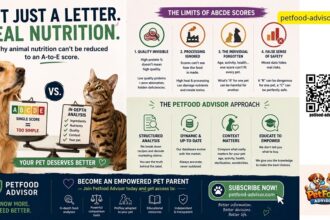
The widespread use of ABCDE petfood scoring systems, often accompanied by color codes such as green, orange, and red, is frequently misunderstood. These systems are sometimes perceived as modern, structured, or even region-specific innovations. In reality, their origins trace back more than two decades to informal online communities in the United States.
Far from being developed within a scientific or veterinary framework, these early scoring methods emerged as grassroots attempts to simplify complex nutritional information into easily digestible formats. While the intention may have been to help pet owners navigate product choices, the resulting models introduced significant distortions that persist today.
Early internet culture and the rise of simplified scoring
In the early 2000s, online forums and discussion groups dedicated to pet care began to grow in popularity. Within these spaces, users sought practical ways to compare commercial pet foods. Without access to structured educational resources, some individuals started creating their own evaluation grids.
These early scoring systems relied on visible elements such as ingredient lists and guaranteed analysis values. Over time, these observations were transformed into rudimentary formulas that assigned points or penalties, eventually leading to letter grades from A to E or similar scales.
Color coding was introduced to reinforce the visual impact of these ratings. Green suggested safety or quality, while red implied risk or poor formulation. This visual layer increased the perceived authority of the system, despite the absence of scientific validation.
The central role of carbohydrate estimation
One of the defining characteristics of these early scoring models was their emphasis on carbohydrate content. Carbohydrates became a focal point partly because they could be estimated using publicly available label data, even though they are rarely declared explicitly.
The typical method involved calculating “nitrogen-free extract” by subtracting protein, fat, moisture, ash, and fiber from 100%. While this approach is widely known, it is also inherently imprecise. Small variations in any of the input values can significantly alter the final estimate.
Despite these limitations, many scoring systems began to treat carbohydrate percentage as a decisive indicator of quality. Products exceeding certain thresholds were systematically downgraded, regardless of other nutritional considerations.
This focus created a distorted hierarchy in which a single estimated variable overshadowed the broader formulation context.
Absence of scientific validation and standardization
A critical issue with ABCDE petfood scores is that they were never subjected to formal validation. No standardized methodology was established, no peer-reviewed framework was developed, and no consensus among veterinary nutrition professionals was reached.
As these systems spread, they were modified, adapted, and reinterpreted by different individuals and communities. Each version introduced its own assumptions, thresholds, and weighting factors.
The result is a fragmented landscape where hundreds of scoring variants coexist, often producing contradictory evaluations for the same product. This inconsistency highlights the lack of reliability inherent in the model.
Global diffusion and persistence of the model
With the expansion of social media platforms, these scoring systems gained international visibility. They were translated, reformatted, and integrated into websites, mobile applications, and online discussions.
Despite their informal origins, they are sometimes presented as authoritative tools. Their simplicity makes them highly shareable, and their visual format aligns well with the rapid consumption of information typical of digital environments.
Today, individuals across many countries continue to rely on these scores when selecting pet food, often without questioning their underlying assumptions.
Health risks associated with oversimplified decision-making
The continued use of ABCDE petfood scores carries tangible risks. When pet owners base their decisions primarily on a letter grade or color indicator, they may overlook critical factors specific to their animal.
Abrupt dietary changes, driven by the desire to switch from a “low-rated” to a “high-rated” product, can lead to digestive disturbances or nutritional imbalances. In some cases, animals with specific medical conditions may be given diets that are unsuitable for their needs.
The problem is not only the inaccuracy of the score itself, but the behavioral response it triggers. Simplified ratings encourage binary thinking—good versus bad—rather than nuanced evaluation.
Misconceptions about the origin and credibility of these systems
It is important to clarify that ABCDE petfood scoring systems are not the result of institutional research, nor are they tied to any particular national scientific initiative. They did not originate in France or within any formal regulatory body.
Their roots lie in informal, user-generated content from early online communities in the United States. This origin explains both their accessibility and their limitations.
The persistence of these systems is largely due to their ease of use and their compatibility with digital communication formats, rather than their scientific merit.
Toward a more reliable approach
Given the complexity of pet nutrition, evaluation methods must go beyond single-parameter scoring and unvalidated grading systems. A more reliable approach involves analyzing multiple dimensions of a product, including ingredient quality, nutrient balance, processing methods, and suitability for the individual animal.
Providing structured, transparent information allows pet owners to engage in a more informed decision-making process. This shift from scoring to understanding is essential to reduce the risks associated with oversimplified models.
Conclusion
ABCDE petfood scoring systems, particularly those centered on carbohydrate estimation, originated over twenty years ago in informal online environments in the United States. Despite their widespread adoption, they lack scientific validation, standardization, and contextual relevance.
Their continued use highlights the need for more robust, educational frameworks that prioritize analysis over simplification. In the field of pet nutrition, informed choices cannot be reduced to a letter or a color.