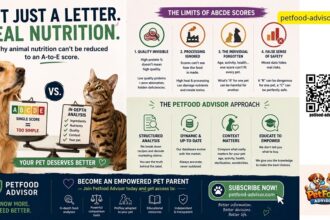
The growing popularity of petfood rating systems has led to the widespread use of simplified scoring models, often expressed through letter grades such as A to E. While these tools aim to make pet food selection easier, they raise significant concerns when their primary evaluation criterion is the carbohydrate content of the product.
A careful examination shows that no ABCDE-style petfood score can be considered reliable, particularly when it relies heavily on a single nutritional parameter.
Carbohydrates: a misunderstood and often misused metric
Carbohydrates have become a focal point in many online discussions about pet nutrition. Some scoring systems assume that lower carbohydrate levels automatically indicate higher quality. This assumption is not supported by a comprehensive understanding of animal nutrition.
In most commercial pet foods, carbohydrate levels are not explicitly stated. They are typically estimated using indirect calculations based on analytical constituents. These calculations are sensitive to rounding, moisture variation, and labeling tolerances, which introduces a degree of uncertainty.
Furthermore, carbohydrates are not a homogeneous category. Their physiological impact depends on factors such as ingredient source, processing methods, fiber content, and overall formulation. Evaluating a product based primarily on an estimated carbohydrate percentage ignores these complexities.
Structural weaknesses of ABCDE scoring models
The fundamental issue with ABCDE petfood scores lies in their reductionist design. By condensing multiple nutritional variables into a single grade, they create an illusion of objectivity while masking methodological limitations.
Different scoring systems often apply inconsistent thresholds and weighting schemes. As a result, identical products may receive conflicting ratings depending on the chosen model. This inconsistency undermines their credibility as decision-making tools.
More importantly, these systems do not account for individual variability among animals. Nutritional adequacy cannot be determined independently of factors such as age, metabolic status, health conditions, and activity level. A fixed letter grade cannot reflect these dynamics.
The amplification of misinformation in online communities
Social media platforms, particularly large discussion groups, play a significant role in shaping perceptions of pet nutrition. Within these environments, simplified scoring systems are frequently used to support categorical claims about product safety or toxicity.
In some cases, these claims evolve into broader narratives suggesting that entire categories of pet food are harmful. Such statements are rarely supported by rigorous evidence and often rely on selective interpretation of data or anecdotal reports.
The combination of simplified scores and alarmist messaging can lead to inappropriate feeding decisions, including abrupt dietary changes that may negatively affect animal health.
The informational role of Petfood Advisor
In this context, the role of an informational platform becomes essential. Petfood Advisor is not designed to assign grades or rank products through simplified scoring systems. Its purpose is to provide structured, transparent, and accessible information.
This approach enables consumers to:
- Interpret ingredient lists with greater accuracy
- Understand the limits of calculated nutritional values
- Identify common misconceptions about macronutrients
- Evaluate marketing claims critically
- Distinguish between evidence-based information and speculative assertions
By focusing on education rather than classification, Petfood Advisor supports a more rational and informed decision-making process.
From prescriptive ratings to analytical frameworks
A reliable evaluation framework should not impose a universal judgment. Instead, it should facilitate analysis by presenting relevant data in a clear and contextualized manner.
This shift from prescriptive scoring to analytical interpretation is particularly important in a field where variability is the norm. Nutritional suitability cannot be reduced to a single metric, nor can it be standardized across all animals.
Providing tools for understanding rather than definitive answers encourages more responsible and adaptable feeding choices.
Conclusion
ABCDE petfood scores, especially those centered on carbohydrate content, lack the methodological robustness required for reliable evaluation. Their simplified structure, combined with estimation uncertainties and contextual limitations, significantly reduces their practical value.
In an environment where misinformation can spread rapidly, prioritizing transparent, evidence-based information is essential. A framework focused on analysis and understanding offers a more appropriate response to the complexity of pet nutrition.