The illusion of the “Yuka for kibble”
The idea of a “Yuka for pet food” is attractive because it promises speed, simplicity, and reassurance. In a market filled with confusing labels, marketing claims, and contradictory advice, many pet owners naturally want a fast answer.
Scan the product. Read the score. Decide.
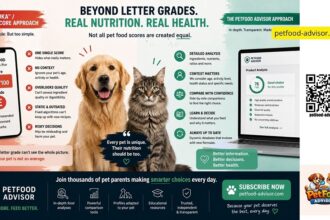
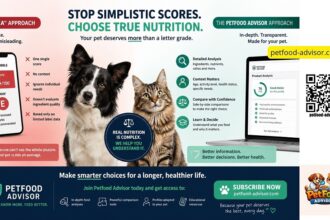
This model seems practical, but it creates a dangerous illusion. A letter grade or a color code may appear objective, yet it often hides the most important nutritional realities. Pet food cannot be judged like a snack, because many dogs and cats eat the same product every day for months or years.
Human food and pet food do not follow the same logic
A human diet is varied. One poorly rated product can be balanced by other meals. For a dog or a cat, kibble or wet food may represent almost the entire daily ration.
That difference changes everything.
A poor evaluation is not just a small mistake. It can become a repeated nutritional imbalance. Day after day, the same formula is consumed again and again. This is why a universal A-to-E score is too simplistic for animal nutrition.
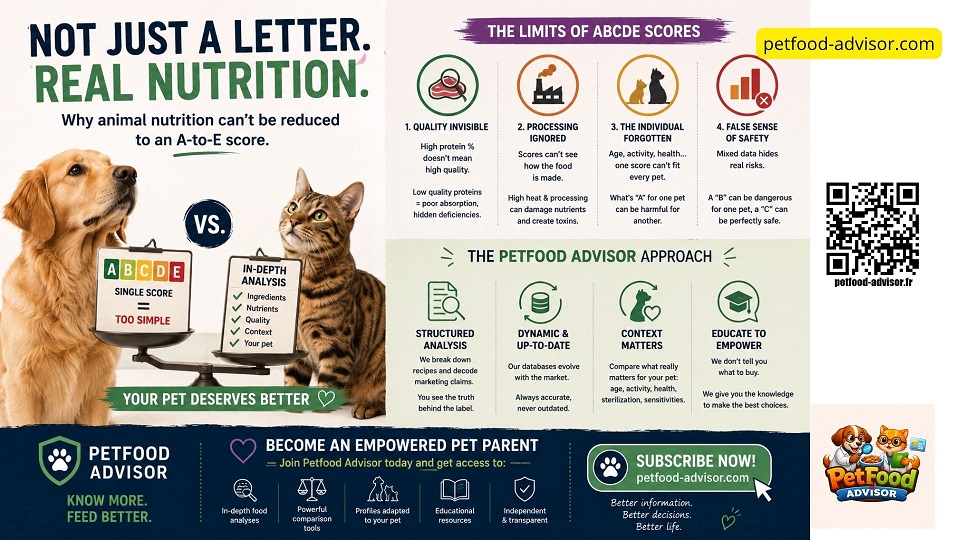
The four major flaws of ABCDE pet food scores
The first problem is that a score cannot properly evaluate protein quality. A product may show a high protein percentage, but that number does not reveal digestibility, amino acid balance, or the real biological value of the ingredients.
The second problem is that manufacturing processes remain largely invisible. A label does not fully explain how the product was cooked, transformed, stabilized, or preserved.
The third problem is that universal scores ignore the animal itself. A young active dog, a sterilized indoor cat, a senior animal, and a pet with digestive sensitivities cannot be evaluated with the same criteria.
The fourth problem is that global scoring systems mix very different data into one artificial result. Minerals, estimated carbohydrates, fats, additives, proteins, and label claims cannot be responsibly compressed into a single letter.
The Petfood Advisor approach
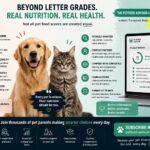
Petfood Advisor rejects the logic of instant verdicts. The goal is not to tell pet owners what to buy through an opaque algorithm. The goal is to help them understand what they are feeding their animals.
This means analyzing products through several dimensions: ingredients, estimated carbohydrates, fat quality, mineral balance, protein levels, moisture, fiber, and suitability for the animal’s profile.
Petfood Advisor also relies on evolving databases, because pet food recipes change. A static score can quickly become obsolete, while a dynamic approach makes it possible to follow changes in the market more realistically.
From passive scoring to informed decision-making
A scan is faster than an analysis, but speed is not always safety.
Responsible feeding requires more than accepting a letter on a screen. It requires understanding the product, questioning the data, comparing several criteria, and considering the real needs of the animal.
This is why Petfood Advisor promotes education instead of blind obedience to a score. It helps pet owners move from emotional reactions to structured reasoning.
Conclusion
Animal nutrition cannot be reduced to a letter, a color, or a score out of 100. Dogs and cats depend on humans to make informed choices, and those choices deserve more than simplified rankings.
Petfood Advisor offers another path: clearer information, better comparison tools, and a more responsible way to understand pet food.