The growing success of simplified pet food scores
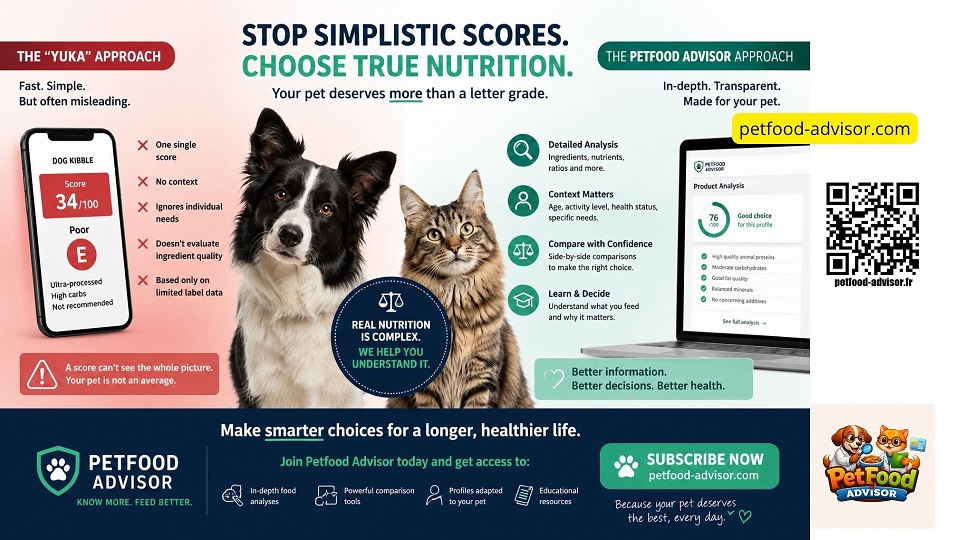
In recent years, many pet owners have started searching for a fast and reassuring way to compare dog and cat food. Inspired by applications such as Yuka and simplified nutritional systems like Nutri-Score, several websites and influencers have attempted to create instant “petfood scores” based on letters, colors, or numerical ratings.
The concept appears attractive at first glance. A consumer scans a barcode, receives a score in seconds, and believes the product has been objectively evaluated. In a market filled with marketing claims, technical labels, and emotional advertising, this promise of simplicity is extremely appealing.
However, animal nutrition is fundamentally different from human nutrition, and reducing the feeding of a dog or a cat to a single letter or a color can quickly become misleading.

Why pet food cannot be judged like human snacks
One of the biggest misunderstandings comes from applying human food logic directly to pet food.
A human diet is generally varied. People consume many different products throughout the week, and nutritional imbalances from one meal can often be compensated by another. Dogs and cats, on the other hand, frequently consume the same kibble or wet food every single day for months or even years.
This changes everything.
A simplistic score may encourage a consumer to switch suddenly to a product that appears “better” on paper but is not adapted to the animal’s physiology, age, activity level, digestive sensitivity, or medical condition.
An active working dog does not have the same nutritional requirements as a sterilized indoor cat. A growing puppy cannot be evaluated with the same criteria as a senior dog. A food suitable for a healthy animal may be inappropriate for an animal suffering from digestive disorders or urinary problems.
Yet many simplified scoring systems attempt to create universal classifications as if one algorithm could answer every situation.
The illusion of objectivity
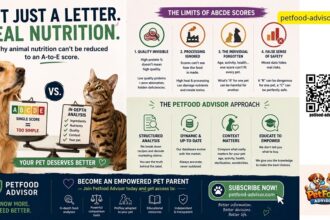
Many “petfood-score ABCDE” systems create an impression of scientific precision while relying exclusively on limited public label information.
In reality, several essential factors cannot be evaluated through a quick scan:
- The true quality of protein sources
- The digestibility of ingredients
- The industrial processing methods
- The biological availability of nutrients
- The long-term adaptation to a specific animal
- The consistency of manufacturing quality
Two products can display similar analytical values while having very different nutritional realities.
For example, a high protein percentage alone says nothing about the biological quality of those proteins. Protein digestibility, amino acid balance, raw material sourcing, and manufacturing conditions all influence the final nutritional value.
This is precisely where many simplified applications become problematic: they transform highly complex nutritional science into emotional marketing tools.
The social media effect
Simplified scores work extremely well on social networks because they generate instant reactions.
A shocking screenshot showing “bad kibble” or “dangerous ingredients” spreads much faster than a detailed nutritional explanation. Emotional content performs better than nuance.
As a result, many consumers are exposed to viral rankings that present products as “good” or “bad” without explaining the limitations of the methodology behind those claims.
This phenomenon has also encouraged the multiplication of copycat “petfood-score” systems. Some are created by influencers with no formal background in animal nutrition, while others simply recycle outdated scoring formulas already criticized years ago.
The result is confusion for consumers and, in some cases, harmful feeding decisions based on oversimplified interpretations.
The philosophy behind Petfood Advisor
Petfood Advisor follows a completely different philosophy.
Instead of assigning universal ABCDE ratings to products, the platform focuses on helping consumers understand the available information and compare products using transparent criteria.
The objective is not to replace critical thinking with an opaque algorithm.
The goal is to provide educational tools allowing pet owners to analyze:
- Estimated carbohydrate levels
- Protein percentages
- Fat content
- Mineral balance
- Fiber levels
- Moisture
- Ingredient lists
- Product positioning
- Nutritional context
This analytical approach encourages comparison and interpretation rather than blind trust in a simplified score.
Why context matters more than a letter grade
A food classified as “excellent” by a generic scoring algorithm may still be poorly adapted to a specific animal.
Likewise, a product receiving a mediocre score could actually be perfectly appropriate in a particular veterinary or physiological context.
This is why Petfood Advisor emphasizes contextual analysis instead of emotional ranking systems.
Nutrition is not a competition between colors or letters.
It is a balance between the individual needs of the animal, the composition of the product, the quality of information available, and the long-term feeding strategy.