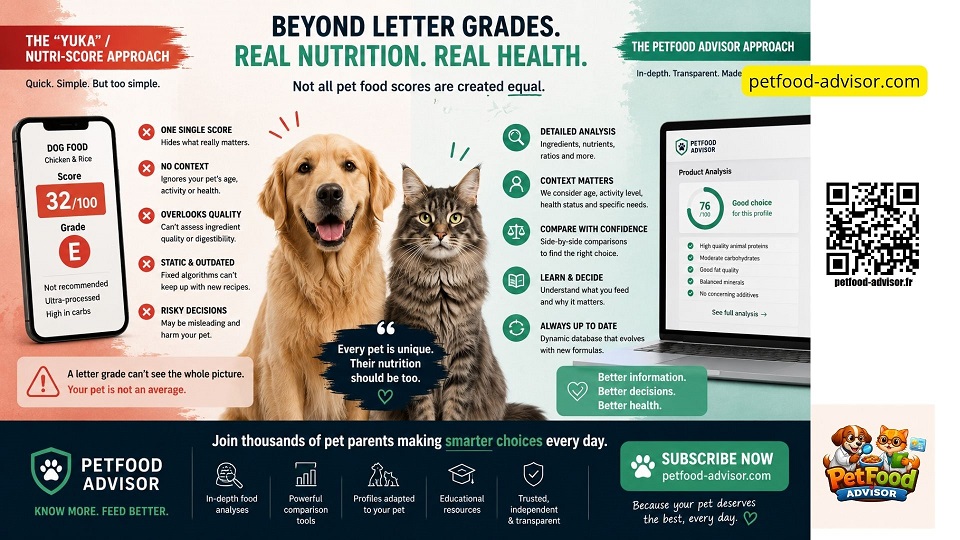
The rise of instant pet food ratings
The success of applications such as Yuka and simplified systems like Nutri-Score has profoundly changed consumer habits in human nutrition. Many people now expect instant answers when shopping: scan a product, receive a score, and make a decision within seconds.
This trend has rapidly expanded into the world of pet food.
Dog and cat owners increasingly search for quick solutions capable of telling them whether a kibble or wet food product is “good” or “bad.” As a result, numerous “petfood-score ABCDE” systems have appeared online, often promising scientific objectivity through simple color codes or numerical ratings.
At first glance, these systems seem reassuring. They provide immediate guidance in a market filled with technical labels, aggressive marketing claims, and contradictory information shared on social media.
But animal nutrition is not compatible with such radical simplification.
Why pet nutrition is fundamentally different from human nutrition
One of the main problems with applying a “Nutri-Score logic” to pet food is that dogs and cats do not eat the same way humans do.
Human diets are naturally varied. A person may consume dozens of different foods during the week. An imperfect meal can often be balanced by healthier choices later in the day.
For dogs and cats, the situation is completely different.
Many pets consume the same kibble every day for months or even years. Their food often represents nearly 100% of their nutritional intake over long periods of time.
This means that mistakes caused by oversimplified nutritional evaluations can have much more significant consequences.
A product that appears “excellent” according to a generic scoring algorithm may actually be poorly adapted to the specific needs of a sterilized cat, a senior dog, a highly active animal, or a pet suffering from digestive sensitivities.
Nutrition is contextual.
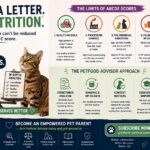
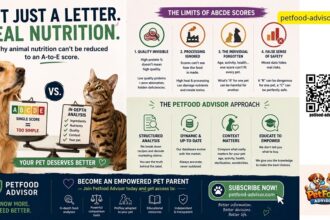
Yet many simplified scoring systems attempt to transform highly complex physiological realities into universal ABCDE rankings.

The hidden limitations of barcode scoring systems
A barcode scan cannot reveal the true nutritional complexity of a product.
Most instant rating applications only analyze public label information and apply algorithmic weighting systems. However, several essential criteria remain invisible:
- Ingredient digestibility
- Biological quality of proteins
- Nutrient bioavailability
- Manufacturing quality
- Cooking temperatures
- Ingredient sourcing
- Long-term formulation consistency
Two products may display similar analytical values while having dramatically different nutritional realities.
For example, a high protein percentage may look attractive, but where do those proteins come from? Are they highly digestible animal proteins or lower-quality plant-based protein concentrates? A simplified algorithm often cannot answer such questions properly.
Likewise, a low-carbohydrate formula may appear “better” online while being nutritionally unbalanced for a specific animal profile.
This is why reducing pet nutrition to a single score can create a dangerous illusion of scientific precision.
Social media rewards emotional content, not nuance
Simplified pet food rankings spread rapidly because they are highly compatible with social media algorithms.
A screenshot showing “bad kibble,” “toxic ingredients,” or dramatic ABCDE classifications generates immediate emotional reactions. These posts are shared far more often than nuanced educational explanations.
As a consequence, consumers are increasingly exposed to viral charts and rankings that oversimplify nutritional science.
Some systems are copied endlessly by influencers who present themselves as specialists despite having limited knowledge of animal nutrition. Others rely on outdated methodologies created many years ago and simply recycled under new branding.
The problem is not only misinformation.
The real danger is that frightened consumers may suddenly change their pet’s diet based entirely on emotional social media content rather than careful analysis.
The Petfood Advisor philosophy
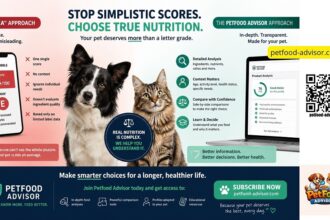
Petfood Advisor deliberately refuses the “instant verdict” model.
Instead of assigning universal A-to-E ratings, the platform focuses on helping consumers understand what they are feeding to their animals.
This approach is based on education, transparency, and contextual analysis rather than emotional simplification.
Petfood Advisor encourages users to compare multiple objective criteria, including:
- Protein levels
- Estimated carbohydrate content
- Fat percentages
- Mineral balance
- Moisture
- Fiber content
- Ingredient composition
- Product positioning
- Physiological adaptation
The objective is not to tell consumers what to buy blindly.
The objective is to provide tools allowing pet owners to make more informed and responsible decisions.
Why dynamic analysis matters
One major weakness of many fixed scoring systems is their inability to evolve with the market.
Pet food formulations change constantly. Manufacturers frequently modify ingredients, suppliers, additives, and recipes.
A static score quickly becomes outdated.
Petfood Advisor instead relies on evolving databases and dynamic analytical approaches capable of adapting to market changes over time.
This creates a more realistic and transparent framework for nutritional comparison.
Teaching consumers instead of replacing critical thinking
Petfood Advisor promotes a philosophy that differs radically from “scan-and-obey” applications.
The platform encourages pet owners to develop their own understanding of labels, ingredients, and nutritional concepts.
This educational approach may require slightly more effort than reading a colored letter on a smartphone screen, but it also reduces the risk of blind trust in opaque algorithms.
Because in animal nutrition, the simplest answer is not always the safest one.
Nutrition cannot be reduced to a color or a letter
The popularity of simplified pet food scores reflects a real consumer need for clarity and transparency.
But clarity should not come at the expense of scientific nuance.
Dogs and cats are living beings with unique physiological needs, not standardized consumers compatible with universal nutritional labels.
That is why Petfood Advisor promotes detailed analysis, contextual interpretation, and consumer education rather than simplistic ABCDE classifications.
Because feeding an animal responsibly requires more than a barcode scan and a colorful rating.